PID controller
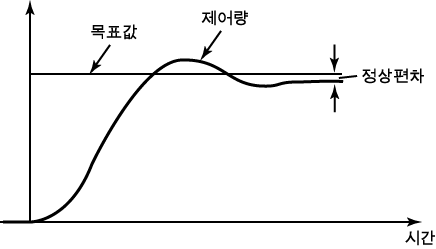
프로세서 제어 시스템 : 김상진 : ...... 프로세스 제어에 사용되는 컨트롤러를 프로세스 컨트롤러라고 하는데, 여기서도 표준 제품이 사용되는 경우가 많다. 컨트롤러의 역할은 편차를 없애는 방향으로 제어량을 변화시키는 제어 신호를 만들어내는 것이다. 그 기본은 서보 메커니즘의 컨트롤러 부분에서 설명한 바와 같이, 편차에 비례하는 제어 신호를 만들어내는 비례 동작이지만, 프로세스 컨트롤러에서는 적분 동작과 미분 동작의 기능이 추가된다 ......... 비례, 미분, 적분에 상당하는 영어의 머리글자를 따서 비례 동작, 적분 동작, 미분 동작을 각각 P 동작, I 동작, D 동작이라고도 한다. 또 이 3 가지 기능을 갖고 있는 컨트롤러의 기능을 PID 컨트롤러, 그리고 PID 컨트롤러에 의해 제어하는 것을 PID 제어라고 한다 ....... PID 컨트롤러는 항상 PID 의 모든 기능을 반드시 작용시켜야 하는 것은 아니고 상황에 따라서 P 동작과 I 동작의 조합, 또는 P 동작과 D 동작의 조합으로 이용되도록 바꿀 수 있다 ......
Wikipedia : PID controller : A Proportional-Integral-Derivative controller is a standard component in industrial control applications. It measures an "output" of a process and controls an "input."
The basic idea is that the controller reads a sensor. Then it subtracts the measurement from a desired "setpoint" to determine an "error".
The error is then treated in three different ways simultaneously:
The sum of the above is added to the last output of the PID loop. This eliminates any constant offset in the control behavior.
The output variable is used to calculate the rate-of-change, rather than the error, because a change of setpoint induces a non-linear step-function in the error. This can make the loop oscillate. The output variable is always continuous, and yet still closely reflects the error's actual behavior.